La crise de production de semi-conducteurs de 2021 a donné à voir le rôle que joue Taiwan dans l’économie globale et dans la production de composants électroniques avancés ...
SynopsisThis working paper provides the first comprehensive approach published that guides organizations on how to calculate upstream water withdrawals and consumption associated with purchased electricity. In addition to a structured methodology, the guidance document provides international country-level and U.S. subnational-level water use factors detailing grid average water withdrawal and consumption resulting from electricity consumption.

The demand for ultrapure water (UPW) has been increased over the past decades. UPW production now occupies an almost equivalent position with seawater desalination in the world water market, fulfilling the demands of various industrial purposes. As an extremely low level of contaminants is required, the typical UPW production system combines 5 to10 purification technologies including ultrafiltration (UF), reverse osmosis (RO) and ion exchanger (IX). In recent years, RO has been at the forefront of this elaborate process as the majority of impurity rejections is carried out with it. This study provides a comprehensive review of the rising role of RO to satisfy the technical requirements in the UPW sector, with an emphasis on electronic industrial applications. The major transitions in recent UPW production are first reviewed: 1) ever-increasing water quality demand, 2) introduction of electrochemical processes into the water polishing stage and 3) UPW waste reclamation, all of which emphasize the enhanced responsibility of RO for producing cleaner permeate. Additionally, the noteworthy insights of RO technologies for the purpose of UPW are summarized, specifically focusing on RO configurations appropriate for UPW, scaling mitigation techniques for high recovery operation, and cleaning methods for maintenance. Lastly, this review concludes with future research directions for UPW production systems to achieve successful implementation.
Article technique survolant l'osmose directe incluant les principales différences par rapport à l'osmose inverse (publié dans Vecteur Environnement, 51(4), 41-45, 2018

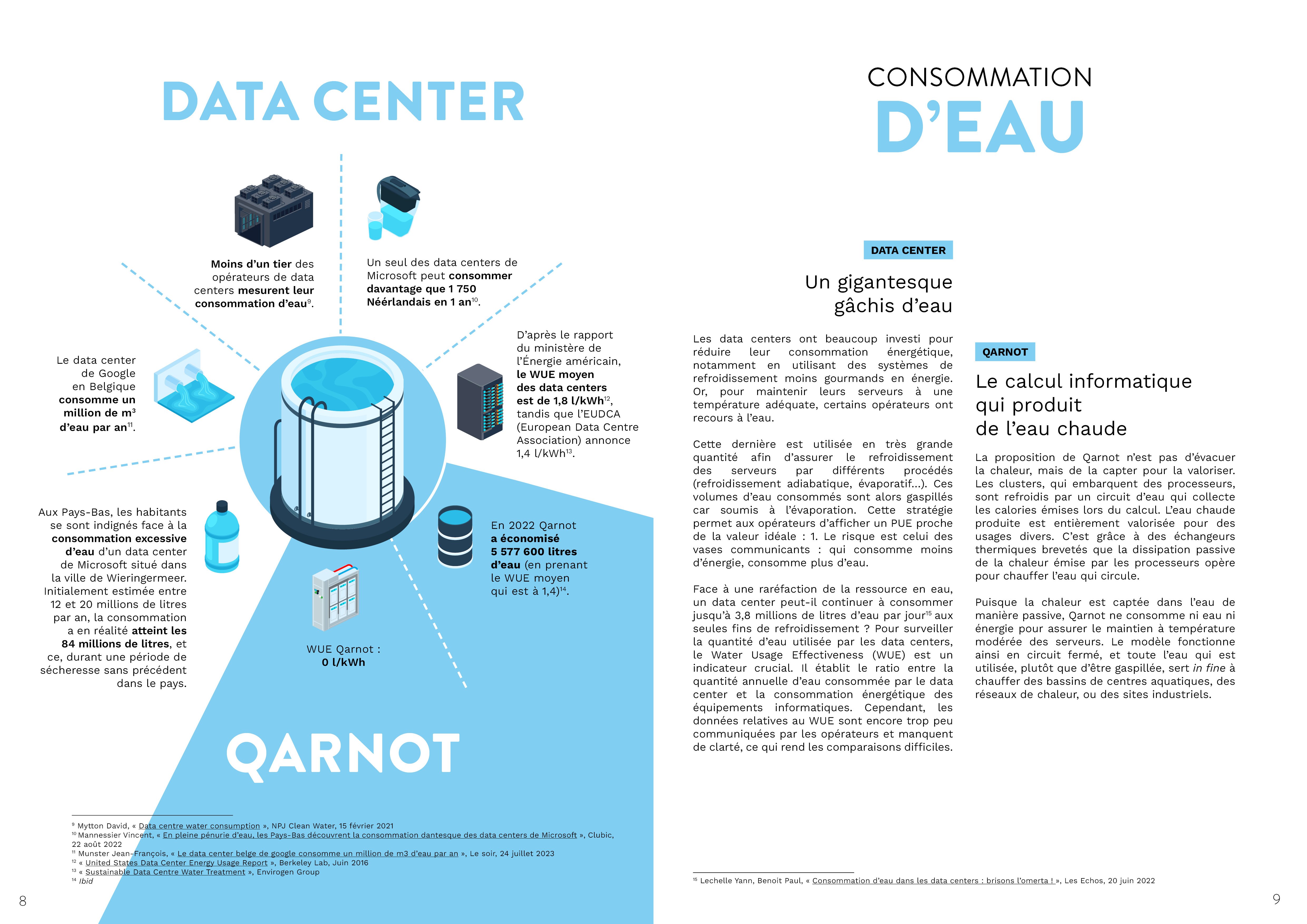
Along with energy, reducing water usage is another challenge that data center operators must address. Both issues are inextricably linked.

Data centers use significant amounts of water for their cooling systems and this usage is gaining recognition in water-stressed regions of the world.